Showing posts with label Child marriage. Show all posts

Sunday, 17 January 2016

Child Marriage - World minimum marriage age:

0 Comments
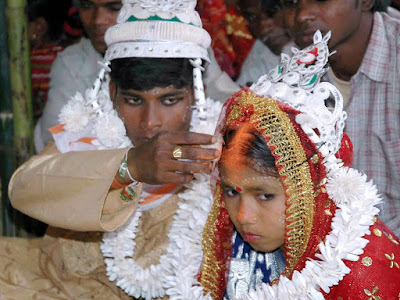
Child Marriages were indeed common India, even though the law requires it to be 21 for a girl. It was amazing to see 12-14 years common with the Latin American and Middle East nations. Iran allows it to be 9 and Saudi at 10. This practice needs to go.

Mike Ghouse

World minimum marriage age: Chart shows the lowest age you can legally get married around the world


http://www.independent.co.uk/news/world/the-lowest-age-you-can-legally-get-married-around-the-world-10415517.html

You can get married as young as nine in Iran but men have to wait till they're 22 to tie the knot in China


Child marriage is still widespread in India despite laws raising the minimum age to 18 for women and 21 for m
On Friday, the Spanish government announced it was to raise the marriage age from 14 to 16 to bring it into line with the rest of Europe.
Estonia now has the lowest marriage age in Europe with teenagers able to get hitched at 15 with parental approval.
Globally, the average legal age of marriage for boys is 17 and 16 for girls but many countries permit them, particularly girls, to marry much younger.
Several places, including the state of Massachusetts in the United States, allow girls as young as 12 to get married in "exceptional circumstances" with the consent of a judge.
But in many cases this is a leftover from an earlier age and is rarely tested. Many countries with low marriage ages do not have a particularly high number of under 18s getting married.
Other countries only permit marriage among the young for certain groups. For instance, according to the US state department's humans right report on Trindad & Tobago from 2014, though the official marital age is 18 for men and women, Muslims and Hindus have a separate Marriage Act.
Muslims are permitted to get married at 16 for men and 12 for girls and Hindus at 18 and 14. The ages for Muslim marriage are shown in the table.
Meanwhile, Chinese lovebirds have to wait the longest, with men waiting until 22 and women until 20, due to Chinese population control policy that aims to limit the number of children a couple will have.
Note: The data is for the youngest possible age it is legal to get married with parental consent. Ages for legal marriage without parental consent will be higher.
Key: 
* Varies between different states or regions within country, lowest permitted age shown
** Judicial consent needed, lowest age considered shown except for countries where there is no lower limit 
*** Certain religious, cultural or tribal groups are permitted to marry younger, lowest permitted age shown 
**** Sharia law
^Unconfirmed
The data only shows the age at which it is legal to get married.
Many of these countries will either turn a blind eye to underage marriage or are struggling to crack down on it for a variety of reasons. Several other countries do not criminalise child marriage outright, the marriage is just considered invalid.
Many young girls are forced to become "common law wives" before they reach the age they can be legally wed.
In countries like India, where the legal age for marriage is 18 for women and 21 for men, the person who was a minor at the time has to file a complaint to get the marriage annulled. This limits the effectivness of the legislation.
In 2013, the country had an estimated 10m women aged 20-24 who had been married before they were 18, according to US Council on Foreign Relations.
According to the campaign, Girls Not Brides, one in three women in the developing world are said to be married before they turn 18.
In Niger, where the age of legal marriage for girls is 15, 76 per cent of girls are believed to be married before their 18th birthday.
Girls Not Brides' executive director, Lakshmi Sundaram told the Independent: "A range of international treaties and conventions point to the need for setting a minimum age of marriage of 18. Most countries around the world have laws that set a minimum age of marriage.
"However even if the law exists, there are a number of reasons why they may be undermined. Pluralistic legal systems may prioritise customary or religious law over national law, exceptions may be granted upon parental consent or authorisation by the court and law enforcement officials maybe poorly trained or lack awareness of the minimum age of marriage.
"Furthermore, countries which lack birth and marriage registration systems don't have the adequate safeguards to protect girls from child marriage."

Tuesday, 2 December 2014

The trauma of Syria's married children

0 Comments
Maha is a 13-year-old Syrian refugee. At the age of 12 she was forced to marry her 23-year-old husband due to financial difficulties and fear of sexual assault. She is now one month pregnant. Due to her young age, her pregnancy is very weak. She hasn�t been in school since she was 10 years old.
"First of all, I didn't want to get married because I am too young, but my parents forced me to. Second of all, we heard about a lot of rape and kidnapping cases in Jordan. But no, not at all. I didn't want to get married. I am still young, and I wanted to finish my studies." says Maha.

Nadia and her sister Sama fled from their home in Damascus, and were married when they were 15 and 17 years old, in Amman where they currently live.
�I got married when I was 15 years old,� says Nadia, 16, �I was forced to marry because my family and I � ten people � were sharing a very small house with only two rooms� I was aspiring to become a doctor. I left school and didn�t finish my 11th year and came to Jordan. Everything got destroyed.�   
The sisters came with their family and their husbands family (their relatives) and due to cultural norms and financial constraints, the girls were married to their male cousins. Sama recently gave birth to her first child Ahmed.
"These girls, who by fleeing the war in Syria have already been subjected to more than any child should, are at extreme risk of mental health issues resulting from social isolation, stress and abuse," said Saba Al Mobaslat.
"Since I got married I don't feel anything," says Reem, 15, "I do feel sad when I see other girls from my neighbourhood going to school. Whenever I see a woman who has become a doctor or a lawyer or has finished her education I get upset."

Thursday, 24 July 2014

Syrian mother's agony: why I made my teenage daughter become a child bride

0 Comments


Um Rulla

We left in February last year: me, my husband Ahmed and our seven children � two sons and five daughters. I borrowed 5,000 Syrian pounds (�20) from my mother to hire a car to drive us from our home in Deraa to the border with Jordan.
When we got to the borderlands, we had to walk with other Syrian families who were fleeing Syria too. We were walking at night to avoid being spotted by Syrian security, who would shoot at us. It was so risky, but I was more scared of what would come next, what sort of life we would have in the refugee camp.

Finally we got into Za'ateri camp, which was like paradise compared with the hell of Deraa. And yet I became worried about the safety of my five daughters. My husband is old and not well, and my sons are little boys. There is no one to protect us. The tents are too close to each other, young men would pass by and stare at our tent.
My eldest daughter, Rulla, was 13 and is attractive. She and her other sisters could not even change their clothes in the tent. We were so scared that my daughters and I might be attacked by strangers. The camp was full of men of different ages. I could not let my daughters go alone to the bathroom, I had to take them one by one even though the bathrooms were far away. Along the way we would be harassed by young men. If any of my daughters wanted a wash, we would have a basin in the tent, and I or my mother would keep watch in case anyone came.
Looking around I could see that families were trying to get their daughters married by any means, even if they were only 12 or 13. They were not asking for dowries, they just wanted a man for their daughters.

My daughters were a huge burden to me. I never thought I would think of them like that. I was so glad when they born. You can't imagine the fear of a mother when she looks at her daughter and she thinks that she might be raped at any moment. It is horrible to think if the rape story became known publicly, her uncles would kill her immediately. I felt like dying when I thought of that moment.
Most of the marriages in the camp are for girls of 12, 13 or 14, but even 10-year-olds might get engaged if they are tall and developed. The way it works is that a female relative of the groom tours the tents to find a girl. When she finds someone suitable, she brings her to the man, who asks for her hand. The groom might be Syrian or Jordanian or from other Arab nationalities.
A 70-year-old Saudi man married the daughter of my neighbour. She was already engaged to a Syrian man but her family could not believe their luck in getting a rich Saudi, so they dumped the first groom to make way for the second. The Saudi man had to pay the family 1m Syrian pounds to marry their young daughter.
It was a big shock when an old Jordanian man came to my mother's tent asking for her hand. He said that he wanted to provide her with a better life and spare her humiliation. These Jordanians are really exploiting Syrian refugees' terrible circumstances.

An acquaintance in a nearby tent had an 18-year-old nephew, Omer, who worked in an embroidering workshop. She told him about our daughter, came to our tent and told us that she wanted Rulla for her nephew. Rulla blushed in astonishment. For me, it was hard to accept the idea. She was still a child, playing with kids in the camp. But the war, hunger, humiliation and fear forced me in the end to accept the offer. It was difficult to throw my daughter into a new life I do not know and she herself does not know either. Rulla knew nothing about marriage, I had to teach her every single thing.
We rented two houses in Amman, one for Omer and one for us. The groom brought jewellery and even paid for a wedding ceremony. We had to take in the wedding dress to make it fit Rulla's tiny body. I had to tell her how to behave with her husband. I asked her if she loved her groom. She said she did, but I was not sure that she knew the real meaning of love.
I fumbled to illustrate things to her bluntly. I told her that her husband might get too close to her, he would kiss her and she should not shudder but welcome that. I did not want to scare her with the whole story of marriage. I told her that her husband would teach her how to be a good wife. I sat for two hours with the groom himself before he married my daughter. I tried to prepare him for the fact that he was getting married to a child, not a mature woman, and that he needed to be more tolerant with her.

The second day after the wedding, I ran to see Rulla and asked her how her night had been. She told me it was OK and that everything went well. I'm praying all the time that her marriage will last. The problem is Rulla can't forget that she is still a child though she is married now. In one of my visits, it was terribly shocking to see her wearing socks and slipping about on the floor like other children in the house. I told her she should not do that because she is a married woman now. She said:"Oh mum, I really like to run like before and play with other girls."
Rulla now lives with her husband's family because she needs her mother-in-law to guide her. She has been married for five months now. I do not think her husband will allow her to complete her studies. He wants her to focus on her house and kids.
Ten days ago, I took Rulla to the hospital, thinking she was pregnant but the doctor found that she had an ovarian cyst. That was bad and good news for me at the same time. Deep in my heart I was content that she won't get pregnant soon because she herself is still a child and her marriage is not documented, which means the baby would not have a birth certificate. I still ask myself every day if I was fair to Rulla.

pls read full article its harrowing.

Saturday, 8 February 2014

Tuesday, 26 November 2013

British Muslims Should Stand Up and Say It: There Is Nothing Islamic About Child Marriage

0 Comments


This is a column about Muslims and child marriage. I hesitated before writing it. When I pointed out the prevalence of anti-semitism and homophobia within British Muslim communities earlier this year, I was accused by some of my co-religionists of "selling out", of "fuelling Islamophobia".
I understand their annoyance. Why give the racists and bigots of the Islamophobic far right yet another stick with which to beat us?
The problem is that this particular stick is already in their hands. Child, or underage, marriage is very much a part of British society. And the inconvenient truth is that it is Muslims - not Christians, Jews or Hindus - who are responsible for much of it. There is no point pretending otherwise. Nor is it morally tenable to stand idly by as young girls in the UK are forced into marriages before they are physically or psychologically ready, against their will and against the law.
First, a bit of background. The legal age for marriage in Britain is 16. Yet, back in October, I watched ITV's Exposure documentary, 'Forced To Marry', in which two undercover reporters, posing as the mother and brother of a 14-year-old Muslim girl, called 56 mosques across Britain to ask whether they would perform the girl's marriage. Shamefully, imams at 18 of those 56 mosques - or one in three - agreed to do so.
The imam of a mosque in Manchester was secretly recorded as saying that performing such a marriage would "not be a problem". An imam in Birmingham, despite being told that the girl didn't want to get married, could be heard saying: "She's 14. By sharia, grace of God, she's legal to get married. Obviously Islam has made it easy for us... We're doing it because it's okay through Islam."
Let's be clear: two-thirds of the imams refused to perform such marriages, with many making it clear they "found the request abhorrent". But here's the issue: a third of them didn't. A third of those imams hid behind their - my! - religion: "We're doing it because it's okay through Islam." Frustratingly, many Muslim scholars and seminaries still cling to the view that adulthood, and the age of sexual consent, rests only on biological puberty: that is, 12 to 15 for boys and nine to 15 for girls.
It doesn't have to be this way. As is often the case, there is no single, immutable 'Islamic' view. As Usama Hasan, a reform-minded British Muslim scholar and former imam, argues:
"There was a rival view in Islamic jurisprudence, even in ancient and medieval times: that emotional and intellectual maturity was also required, and was reached between the ages of 15 and 21." The latter view, he tells me, "has been adopted by most civil codes of Muslim-majority countries for purposes of marriage".
The Quran does not contain a specific legal age of marriage, but it does make clear that men and women must be both physically mature and of sound judgement in order to get married. It is also worth clarifying that Prophet Muhammad did not, as is often claimed, marry a child bride named Aisha. Yes, I'll concede that there is a saying in Sahih Bukhari, one of the six canonical Hadith collections of Sunni Islam, attributed to Aisha herself, which suggests she was six years old when she was married to Muhammad and nine when the marriage was consummated. Nevertheless, there are plenty of Muslim historians who dispute this particular Hadith and argue Aisha was in reality aged somewhere between 15 and 21.
This isn't a case of 'liberal' Muslims v 'conservative' Muslims, either. Even the much-maligned Muslim Council of Britain has said it is "strongly opposed to [underage marriage] on the basis that it is illegal under the law of the land where we are living and even under sharia it is highly debatable".
Indeed it is. Afifi al-Akiti, an Oxford-based theologian trained in traditional Islamic madrasas across south Asia and North Africa, tells me that the vast majority of classical scholars throughout Muslim history agreed on a minimum marriage age of 18 - two years older, incidentally, than secular Britain's current age of consent.
So, how to explain the view of a third of the imams contacted by ITV? The influence of Saudi Arabia, and its decades-long export of a reactionary, retrograde brand of Islam, cannot be ignored. The damage that has been done to a nascent British Islam by pre-modern, Saudi- inspired, literalist dogma is incalculable. Consider this: in 2011, when the Saudi ministry of justice announced it might prohibit marriages involving girls under the age of 14, Sheikh Saleh al-Fawzan, one of the country's most senior clerics, issued a fatwa to allow fathers to arrange marriages for their daughters "even if they are in the cradle". To call such a mindset outdated or medieval would be a gross understatement. It's an endorsement of paedophilia, plain and simple.
It is also an apt reminder of why most countries, including most Muslim-majority countries, have minimum ages for marriage codified in law: to deter adults from exploiting children and to protect the most innocent members of our society.
"We have a moral duty to obey the law of the land," says al-Akiti. For adult men to try to marry young girls is illegal and immoral. But British Muslims have a special responsibility: to make the case that there is nothing Islamic about underage marriage, either.
Will this column be used by EDL-types to further their pernicious, anti-Muslim agendas? Maybe it will be, but I can't stay quiet. I'm the father of two young girls. When I hear of forced, underage marriages being carried out in the heart of major British cities, I think of my own daughters. And I feel sick.
This is 2013. Not 613. Or 1813. Child marriage is a form of child abuse. It must be stopped.

Tuesday, 8 October 2013

'After the wedding, fear set in': a Yemeni child bride's story

0 Comments
 This made me sick to my stomach :(. 


"My husband provided a dowry of around $150, which was a huge amount. But it was at the end of the wedding that the fear and horror set in. I was taken away from my parents and left with a man who meant nothing to me. He drove me to the house he shared with his widowed father in Al Hudaydah. It was a nice home but I immediately started to quiver, and to cry."
When Al Ahdam, a clerical worker in the city's Red Sea port, took his clothes off in front of Noora for the first time, she ran away. She avoided sex for 10 days, before being told by Al Ahdam's sisters that she was "bringing shame on our brother by rejecting him".
After succumbing to Al Ahdam's advances for the first time, Noora's body went into shock. "I was rushed to hospital � I was a child being treated as a sex object, but the abuse did not stop. Nobody was interested in my complaints, as I was legally a wife."
There were two miscarriages within a year, before Noora gave birth to a son called Ihab when she was 13. A daughter, Ahlam, followed when Noora was 14, and then Shihab, another son, when she was 15. All of the pregnancies were problematic.
Al Ahdam became increasingly violent. "He thought nothing of hitting me, even when I was pregnant," said Noora. "If his father hadn't been in the house, it would have been even worse. His presence was some kind of restraint, but I was still very badly injured." The children suffered too. When Ahlam was two, Al Ahdam grabbed her by the feet and banged her on the floor. The child was taken to hospital bleeding.
After 10 years of constant attacks, Noora joined a project run by Oxfamand the Yemeni Women's Union which assists victims of domestic violence. With their help, she successfully filed for divorce. A further legal battle followed as Noora fought for money to bring up her children. The process is ongoing but she at least managed to return to school and trained as a teacher. Now she is pushing for strictly enforced legislation to end child marriages.

Wednesday, 25 September 2013

The Reason For Yemen's Child-Bride Problem Isn't What You'd Expect

0 Comments


Perhaps the most well-known story from Yemen is that of Nujood Ali who, after fleeing her abusive husband in 2008, became the country�s youngest divorcee at the age of 10. Arwa, another Yemeni girl, suffered a similar experience when she was married off to a man in his forties. When her father was asked why he was willing to marry his daughter off at such a young age, he said, �"He gave me 30,000 rial ($150) and promised another 400,000 ($2,000). I was really in need of money and thought it was a solution for the family.�
Nadim, who married his 12-year-old daughters to older men in order to pay off his creditors, is now an advocate against underage marriage, and he warned other parents: �I�d advise any father, mother, or brother not to rush to marry their girls like I did, because that is ignorant.� These child marriages perpetuate the cycle of poverty as the young girls are deprived of opportunities for education and work, face greater health risks, and are more likely to be victims of domestic and sexual abuse.

Tuesday, 3 September 2013

Rejecting the Myth of Sanctioned Child Marriage in Islam

0 Comments

Excellent article :)
Name one thing Muslims and Christians share? Their level effort pointing fingers elsewhere whenever pedophilia comes up. Catholic priests are an obvious and easy target, but when my 16-year-old daughter raised $26,000 in her high school to combat North America's growing child-sex-slavery trade, her grandmother complained that she wasn't doing enough about misogyny and abuse in Somalia, Saudi Arabia and the Sudan. Although she wasn't very clear how Marley would get there. My pen on the other hand? We'll see.
Another similarity? Neither Muslims nor Christians blame Christianity for the problem, but the same can't be said for Islam. You've got to give pedophiles their props though. Most sane people consider them something beyond abhorrent, and yet on this issue they have convinced even Christian leaders to climb into bed with them, and with some Sunni and Shiite scholars to boot. And it's time to pull the sheets back and see what's really going on for the sake of women and children everywhere.
There are really only three reasons to insist -- as so many do -- that Aisha was only 9 years old when Muhammad, the Prophet of Islam (PBUH) married her: Either you are such a crazy Islamophile that you are willing to go to your grave insisting Muhammad could do whatever he wanted, or you are such a crazy Islamophobe that you want to insist he did, or you are such a weirdly religious sex-crazed pervert that you hope accusing him makes it OK for you to do it too.
There is absolutely no other reason to either make or repeat that disgusting claim. Aisha was married in 622 C.E., and although her exact birthday is unknown, Abu Ja'far Muhammad ibn Jarir al-Tabari recorded that it happened before Islam was revealed in 610. The earliest surviving biography of Muhammad, Abu Muhammad 'Abd al-Malik bin Hisham's recension of Ibn Ishaq's Sirat Rasul Allah -- The Life of the Messenger of Godrecords that Aisha accepted Islam shortly after it was revealed -- 12 years before her marriage -- and there is no way she could have done so as an infant or toddler.
Furthermore, it is a matter of incontrovertible historical record that Aisha was involved in the Battles of Badr in 624 and Uhud in 625, in neither of which was anyone under the age of 15 allowed.
Finally, Imam Wali-ud-Din Muhammad ibn Abdullah Al-Khatib, dead for more than 700 years, recorded in the biographical section of Miskat al-Masabih that Asma, her elder sister of 10 years, died at the age of 100, 72 years after Aisha's wedding. This makes Aisha's age at the time of her marriage at least 14, and at the time of her marriage's consummation almost 20.
Although those dates make it obvious that Aisha's child-marriage couldn't have taken place, according to Arab tribal traditions of the time it could have, and apparently it can still happen in Arabia today. A case that recently raged through the international press and Saudi courts -- of an 8-year-old girl who had been married by her father to a 47 year-old "friend" to settle Dad's debts -- shows how little things there have changed. However, that's despite Islam, not because of it.
Prior to Muhammad in Arabia, it is common knowledge that females were considered property, and that female infants were often discarded like refuse when born. However, one of Islam's primary revelations was that men and women had equal status before God, with different though equal rights and obligations. Another was God's condemnation of Arab female sacrifice, proclaiming that girl-children were just as valuable as boy-children to God and to humankind.
Obviously, those ignorant tribal prejudices and practices persist. However the most important reason Aisha's child-marriage couldn't have happened is this: Muhammad couldn't do anything any more than any other Muslim can. Muhammad was the finest example of true Islamic living there could ever be, and having marital relations with a woman of less than the "age of majority" -- an age that varies from culture to culture but presupposes the ability to become pregnant, have children and make decisions for those children as an adult -- was, is and always will be completely contrary to the example set by our Prophet, and the message of Islam's Holy Quran.

The Quran is clear that a divorced woman cannot marry another man until she completes a period of waiting to confirm she isn't already pregnant, and such an impediment would be unnecessary were pregnancy not possible. However, the roots of Islamic pedophilia lie in exactly what the verse (At-Talaq -- "The Divorce" 65:4) about that waiting period says. Yousuf Ali's English translation is a pretty good approximation:
Waalla-ee ya-isna mina almaheedi min nisa-ikum ini irtabtum fa'iddatuhunna thalathatu ashhurin waalla-ee lam yahidna waolatu al-ahmali ajaluhunna an yada'ana hamlahunna waman yattaqi Allaha yaj'al lahu min amrihi yusran.
Such of your women as have passed the age of monthly courses, for them the prescribed period, if ye have any doubts, is three months, and for those who have no courses (it is the same): for those who carry (life within their wombs), their period is until they deliver their burdens: and for those who fear Allah, He will make their path easy.
Now, I've discussed the verse with progressive Islamic scholars and learned that "Lam Yahidna" negates menstruation in the past tense and the jussive mode and means "did not menstruate," with the expectation that the woman should be menstruating, since that natural cycle is part of her normal state.
Then again, I know that there are Islamic scholars from Arabia and Pakistan -- another place with long traditions of both child-marriage and misogyny -- and Islamophobes from around the world who interpret it as if it says "has not menstruated yet," with the jussive mode implying the girl is impatient to begin, ensuring that it seems to perpetuate the pre-Islamic practice of having sex with pre-pubescent girls.
Between those two incredibly divergent positions, how does one choose?
When Muslims face difficult questions, we have the Sunnah, an Arabic word meaning "the acts of Muhammad," to guide us, and that's why Aisha's age is such an issue. But the thing is, whether Aisha was still a child when her marriage was consummated has never been a question: all scholars agree that occurred after Aisha's menarche. Islamophobes inevitably claim otherwise, but they do so based on a completely fictitious interpretation of events.
And that means the problem that we should be addressing is the root one, that of men devaluing and disenfranchising girls and women: Husbands and fathers treating girls as property and forcing them to marry against their will.
And in that, the condemnation of the Quran and Sunnah are very clear: The Quran states a woman's consent is essential, and the Sunnah confirms that both Aisha's betrothal and consummation occurred with Aisha's enthusiastic agreement. In fact, some even imply she went against the initial wishes of her Dad!
Those guides unequivocally confirm that men and woman have equal status before God, equal though different rights when wed, and that a woman cannot be given in marriage without her express approval. Absent that, the Sunnah also records that Muhammad dissolved marriages on the woman's testimony alone. That is what Muslims should be proclaiming, rather than the purported right of Muslim men to marry underage brides.
The cause of the confusion is simple. Imam Bukhari, compiler of the famous Hadithcollection (Hadith in this context meaning stories about Muhammad) Sahih Bukhari included one recalling that Aisha said she was 6 when betrothed and 9 when she was wed. However, Bukhari included another recording that Aisha was a young girl and remembered when Surah Al-Qamar was revealed -- 9 years before her wedding -- as well. Obviously, both Hadiths can't be true, and that's the problem with relying too much on Hadiths, and too little on the Quran and common sense.
Even if you believe -- as I do -- that the Quran is a divinely protected book, the same cannot be said about all Hadiths. In fact, there is even an Ayah in the Quran that warns about the dangers of thinking otherwise. Luqman 31:6 cautions:
Wamina alnnasi man yashtaree lahwa alhadithi liyudilla aaan sabeeli Allahi bighayri aailmin wayattakhithaha huzuwan ola-ika lahum aaathabun muheenun.
But there are, among men, those who purchase idle Hadiths, without knowledge (or meaning), to mislead (men) from the Path of Allah and throw ridicule (on the Path): for such there will be a Humiliating Penalty.
While there are Muslim scholars who claim that Luqman 6 is actually a warning about musical performers like Madonna, there are others who respond that unless those performers are Muslim nothing they do throws ridicule on any path but their own. And personally, I think the Ayah is instead a frank and literal warning about the dangers of trafficking in false and idle Hadiths, just like it says.
I also can't think of a better set of examples of what it's talking about than the damage that's been done by confusion over Aisha's age of consummation.
I have read a great deal of speculation about why Hadiths that make Aisha seem immature might be wrong. Most of them came out of what is now Iraq, through one specific source named Hisham ibn Urwah. And it's worth noting that his student Muslim -- who collated the Hadiths of Sahih Muslim -- specifically chose not to include any from his respected teacher after Hisham went to Iraq. Some say it's because Hisham's memory became spotty, others say it was because Iraq was a political hotbed of "anti-Aisha" feeling and some evil men fabricated Hadiths in Hisham's name.
But none of the speculation matters. The only thing you need to realize is that both the tales Bukhari included can't both be true. That fact, put together with the Quran's warning, means that Hadiths can't be as authoritative to Muslims as the Holy Quran and the Sunnah are.

I've been told otherwise by many good Muslims, and I know there are even places in the world where you can spark a riot by saying otherwise, but I think that's part of what Luqman warns us about. I love Hadiths for the illuminating light they can shine on the interpretation of a difficult passage, or on my own attempts navigating a difficult juncture in my life, but I've also participated in Islamic dinner events that have fallen apart discussing the Hadith condemning Muslims who smell their food before they eat it.
Now, the role, authority and validity of individual Hadiths is not an issue that is going to be put to rest by someone like me; there is an entire scholarly science devoted to it. And personally, I think that debate and discussion, both between scholars and "grass-roots" Muslims, is useful and instructive whether the Hadiths being discussed are actually "true" or not, as long as that discussion is respectful of both our religion of Islam and our fellow participants.
But while we're on the subject of how Muslims settle Islamic controversies, there's an important question that begs asking. I actually understand the Islamophobic focus on false and embarrassing Islamic interpretations: they're just trying to score points the best way they know how, with tools we Muslims have given them. But all these facts I've shared are just common knowledge that's easily verifiable and my conclusions little more than simple common sense.
If Muslim scholars are so concerned that Muslim practices follow Islam's revelation and Muhammad's memory, and if they truly want to defend Islam and our Prophet, then what have they been doing for the last thousand years?
No question men (and women) can be pigs when it comes to sex and gender issues -- when I'm asked to explain why we can't eat pork I generally explain the problem might be cannibalism -- but religion is supposed to help us combat those dark urges not pander to them.
And while we're on the subject of marriage, the Quran doesn't condone wife-beating either. In pre-Islamic Arabia, men did not need permission to beat their wives. And although the Arabic root Dzaraba does mean "beat" it also means "heal." Dzaraba denotes action for a higher purpose, such as "striking (or minting) a coin," or "striking out on a new path." Coupled with the Quran's warning to husbands that God is watching everything we do, and a reminder that we must serve our marriage rather than ourselves, particularly after proclaiming married men to be tasked as providers and protectors rather than rulers all in the same passage, in Muhammad's day Islam actually took that permission away, despite misogynist Muslim and Islamophobic claims to the contrary.
With all the suffering in Somalia, so much of it caused by misapplied and misinterpreted misreadings of Islam, why are Somalia's scholars focusing on sexualizing hand-holding?
How is it that Saudi Arabia still allows child marriage when they've known Aisha's real age all along (the biographies I reference are written in Arabic, for Heaven's sake!), or that Pakistan's rape laws cleave to British colonial precedent?
In Pakistan, a woman can be punished for being raped if the rapist denies her claims. But when Muhammad was faced with a woman who told him she'd been raped, he had the man in question executed on the testimony of the woman, whom he pronounced blameless, alone.
The simple truth is that all our Muslim scholars since Islam began have been human, limited by the human ability to pander, avoid conflict by bowing to popular opinion, or make mistakes. And when scholars fail their sacred trust, to transmit Islam with fidelity, they lose their right to any authority, Islamic or otherwise, and frankly, it's up to the rest of us to do a better job of keeping them honest.

Because if any of us care about things like "truth" and "fidelity" as much as so many of us claim, "Too busy to check the facts out for myself" just doesn't seem like much of an excuse.
What's my bottom line? The age Aisha attained before she married the Prophet is one issue we have to put to rest -- for the sake of children everywhere. There is absolutely no question that Aisha was an adult when she consummated her marriage with Muhammad of her own free will, and she lived out her life in the earliest days of Islam the un-harassed and proudly participatory equal of everyone, just like every other man, woman or child under God.
That is our Muslim legacy that we should be striving to live up to, and anyone who claims otherwise is simply crazy, one way or another.
 
back to top