Showing posts with label misogyny. Show all posts

Sunday, 10 April 2016

Passionate debate erupts over the future for women in Islam

0 Comments
Indeed, I agree with Zahra, Muslim understanding of Islam needs reform and not Islam.  Hibaq at the very end could have said, both Human rights and Islam go hand in hand, however the abuse of Sharia Law is what needs to be prevented. Farah's focus on the millennials was perfect. Ayan started with the Pew Survey, which is very questionable and even though I wrote about it, and have talked about it on Fox News - it needs more mileage to counter her arguments.  Here is the link questioning the Pew Survey at World Muslim Congress Hiba's comment was great, but somehow it did not make the impact - that is if you want the change the course of the boat, you have to be in the boat.

It is a good discussion, all of them made good points.

Mike Ghouse
# # # 


Sparks flew when Ayaan Hirsi Ali, who lives under a fatwa for her condemnation of Sharia law, came face to face with fellow Somali women�s activist Hibaaq Osman

Saturday, 5 March 2016

Pakistani religious cleric go regressive on Women's right and abuse Sharia.

0 Comments
First of all, congratulations to the Government of Punjab, Pakistan for passing the laws protecting women from abuses of the men, this is a good step in the right direction and it complies with the teachings of Quran and the Prophet.  

Prophet Muhammad (pbuh) was the first influential man in the universe to declare that women have the same rights as men, which were;  to initiate or divorce a marriage, own her own properties, own her own business, and she can walk out of the relationship if her husband pushes her to do things against her faith/will, such was the freedom restored to women by the prophet.  These freedoms were usurped by men all around the world including the United States until 200 years ago where women were considered Chattels. 

Do all Muslims follow this guidance? Hell no. Are all men Misogynistic? Hell no. Are all Christians or others Misogynistic? Hell no.  A majority of people get their faith right and are good honorable individuals, a few don't. We need to avoid painting all for the acts of a few who don't get their religion right. 

Add to that, the powerful accountability factor. The prophet said, on the Day of Judgment, no one is responsible for other's actions, you are responsible for own your deeds, the good and bad you do with fellow beings. That puts women and men on par and individually responsible. No man is responsible for his wife's action or vice versa. 

Of course, men are men; they did not obey the religion, while most of the men did the right thing in following the teachings, a few remained misogynists, which is a men thing and not a religious thing. As you'll find those misogynist brutes are in  every religion and are from every ethnic and racial backgrounds. 
Secondly, this scholar "Muhammad Khan Sherani" says the laws passed by the Punjab Government are wrong and he cites from the Koran and calls the new ruling "un-Islamic". Is he out of his mind?

This takes me back to my old song, that is, shamefully, Muslims have never questioned the books written by "scholars of the past" many of whom were bigots and misogynists, it is not just Islam, scholars in all societies were the same.

We have erred severely by subconsciously giving the same value to their books as Quran. The scholars such as Taymiyyah, Kathir, Maududi, Banna and even Hadiths and Sharia were all compiled by "Men". Even though a whole lot of their material is full of wisdom, they were human and have made serious errors, even though they are a few. It takes one drop of poison to ruin the large body of clean water. We hate admitting that those mighty scholars can err, yes they have and we are paying a price for it by having
 Two Islams. 

When the body of the Sharia Laws was created by humans to serve justice, their intent was good, they wanted a just society, but being human, they made the mistakes and such mistakes need fixing. No one dares fix it, however, the process of questioning has begun now. 

What does it take? Good men and women to speak up, more of them to speak up to created discussion and dialogue and do the right thing.

Mike Ghouse
www.MuslimSpeaker.com 
# # # 

Pakistani Council Declares Law Protecting Women �Un-Islamic�
Courtesy - The Daily Caller News 

A top Pakistani religious council responsible for advising the government to ensure that laws conform with Islam has ruled a new law criminalizing violence against women �un-Islamic.�
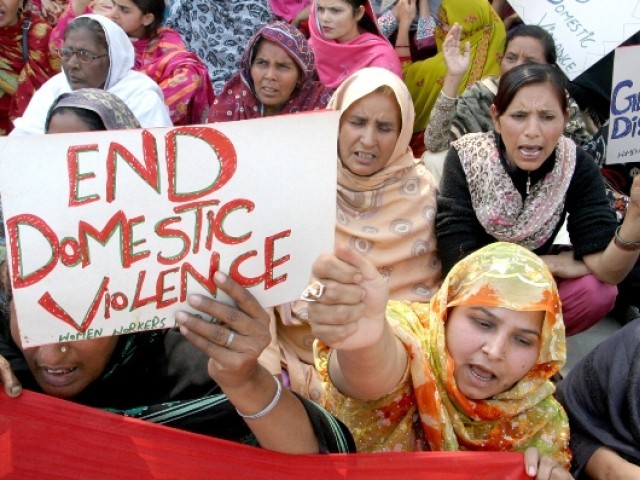
Punjab, the largest province in Pakistan, passed the Women�s Protection Act last week. The law is the first of its kind and is intended to protect women from domestic, psychological and sexual abuse. The legislation will also create women�s shelters and a hotline for women to call in order to report crimes. That is, of course, if of course if the law gets by the Council of Islamic Ideology.
�The whole law is wrong,� said Muhammad Khan Sherani, head of the council, during a news conference. Sherani cited verses from the Koran to back up his claim that the law is �un-Islamic.�
According to its website, �the Council of Islamic Ideology is a constitutional body that advises the legislature whether or not a certain law is repugnant to Islam, namely to the Koran and Sunna.� The Sunna is the verbal record of the practices of the Islamic prophet Muhammad.
 
The council has a history of highly controversial decisions. It defended child marriages in 2014, claiming that girls as young as nine years-old are eligible for marriage. Sherani claimed that any laws in Pakistan defining the age when a girl should be allowed to marry should be repealed. The council also rejected the use of DNA testing in 2013 as a primary source of evidence in cases of rape.
Life for women in Pakistan can often be harsh and even deadly. It has been reported that as many as nine women are killed in the country each day in what are referred to as �honor crimes.� Cases of rape often go unreported due to the difficulty involved in securing successful prosecution of an offender.
In one particularly brutal case, a woman from a village in Punjab was sexually assaulted by as many as 14 men in 2002. Though she survived, her attempts to seek justice and prosecute her attackers took nine years. All but one were acquitted. The case drew international attention, however, she was not allowed to leave Pakistan out of concerns she would flee to the west and attempt to profit from her assault.
�Every year some 2,900 women are raped in Pakistan, almost eight a day,� said Ayesha Hassan, a journalist who covers the issue, to Deutsche Welle.
References: 
  1. Council of Islamic Ideology Government of Pakistan http://cii.gov.pk/ 
  2. Profile of Maulana Muhammad Sheerani - http://cii.gov.pk/aboutcii/Chairmansprofile.aspx
  3. The Sunnah - http://islam.uga.edu/shariah.html#Sunnah
# # #

Monday, 13 July 2015

Afghanistan: No Country for Women

0 Comments


Under the Taliban women were banned from going to school and working. They were not allowed to leave their homes without a male relative or be seen in public without a burqa. For defying the regime's repressive laws, women were openly flogged and executed.
But 13 years after the fall of the Taliban, and despite the influx of billions of dollars in development aid, many Afghan women are still living in terror.
A report by Global Rights estimates that almost 90 percent of women experience physical, sexual or psychological abuse or forced marriage. Overwhelmingly, it is their families who are committing these crimes.
"It's a question of control and power," said Sima Samar, a prominent women's rights activist and chairperson of the Afghanistan Independent Human Rights Commission. "You use religion, you use culture, you use tradition, you use gender to keep the power, to keep control."
When Mariam, 25, got married five years ago, she never imagined that she would end up in a shelter.
"When I first saw my husband I thought he was the right man for me," she said, sitting on the floor of the shelter with her head covered in a black scarf.
"I thought I'd have someone to share my pain and my secrets with. I'd have children and live a happy life."
But she says the abuse began almost immediately. Without warning, her husband would erupt into violent rages, at times threatening her with a loaded gun or dragging her by her hair through their home.
When she tried to seek help from the police, they released her husband after a few hours. Even her parents refused to help her, returning her to her in-laws after assurances that she would not be beaten.
Mariam says her husband was diagnosed with a mental illness and prescribed medication. But the torment continued.
"I thought about killing myself but I couldn't go through with it because I was pregnant. I was so tired. Most of the time I didn't even have the energy to defend myself and nobody was there to defend me," she said, showing no emotion.

Monday, 11 May 2015

Mona Eltahawy: �All religions are obsessed with my vagina�

0 Comments
All religions are obsessed with my vagina | www.WorldMuslimCongress.com

Link: http://worldmuslimcongress.blogspot.com/2015/05/mona-eltahawy-all-religions-are.html

Mona had to use the language she has used to get a sense of freedom, it is a shame men are still misogynistic, get this straight, it is all men and not necessarily Arab or Muslim men.  Men still feel insecure to act and feel equal with women. We need to grow up.
 I feel, believe and act equal with whole humanity and that is the essence of Islam, to be humble.

Mike Ghouse

# # #

Mona Eltahawy: �All religions are obsessed with my vagina�


http://www.theguardian.com/world/2015/may/10/mona-eltahawy-interview-religions-obsessed-vagina-headscarves-and-hymens?CMP=share_btn_fb

Mona Eltahawy is an award-winning journalist and commentator on Arab and Muslim issues and global feminism. Born in Port Said, Egypt, in 1967, she moved to the UK with her parents (both doctors) when she was seven and then to Saudi Arabia when she was 15. In November 2011, while covering the protests in Egypt, she was physically and sexually assaulted by riot police, and detained for 12 hours by the Interior Ministry and Military Intelligence. The following year, her examination of misogyny in the Muslim world entitled �Why Do They Hate Us?� became a viral sensation. She has now expanded the original article into a book, Headscarves and Hymens: Why the Middle East Needs a Sexual Revolution. Eltahawy lives in Cairo and New York.

Your book is part-manifesto, part-memoir and includes testimony from Muslim women who have experienced abuse throughout their lives. You mention cases of female genital mutilation and rape. Was it difficult to write?

Incredibly difficult. Many times, I literally had to walk away from my laptop. It was triggering for me, especially when writing about sexual assault because of my own experience, not just of the assault but of misogyny. It was not an easy book to write.

You write that you were �traumatised into feminism� as a teenager. What do you mean by that?

My family moved to Saudi Arabia from Glasgow when I was 15. Being a 15-year-old girl anywhere is difficult � all those hormones and everything � but being a 15-year-old girl in Saudi Arabia�it was like someone had turned the light off in my head. I could not get a grasp on why women were treated like this. In the UK, my mother had been the breadwinner. I�d seen my parents side by side. In Saudi Arabia, my mother was basically rendered disabled. She was unable to drive, dependent on my dad for everything. The religious zealotry was so suffocating. And I had been raised a Muslim, I came from a Muslim family, but this was ultra-zealous. As a woman in Saudi Arabia, you have one of two options. You either lose your mind � which at first happened to me because I fell into a deep depression � or you become a feminist.

Were you anxious about the outrage you might provoke in some quarters by speaking openly about misogyny within your own community?

I�ve got a lot of hate� But it�s hate from people I�m glad I�m pissing off. As a woman with an opinion, you get a lot of shit.

Are all religions misogynistic?

Absolutely, to some degree. All religions, if you shrink them down, are all about controlling women�s sexuality� They�re obsessed with my vagina. I tell them: stay outside my vagina unless I want you in there.

You call for a �double revolution�. What do you mean by that?

What happened in Tunisia in 2010 was a political revolution driven by recognition that the state was oppressing everybody. But I think when women looked around afterwards, they recognised that the state, the street and the home still oppressed women specifically and that trifecta of oppression means that political revolution, unless accompanied by a social and sexual revolution, will fail.

 Mona Eltahawy explains why Egyptian women are sexually harassed at every level of society.

You decided to wear the hijab at 15. Why?

I wanted to wear it at 15 but my parents said I was too young, so I wore it at 16 and very quickly realised it wasn�t for me. I missed feeling the wind in my hair. When I was eating, it would constrict the way I felt I could swallow.
Advertisement

So you stopped wearing it at 19�

I became a feminist while wearing the hijab and to people who challenged that I would say: �This is my way of choosing which parts of my body I show you, so that you don�t objectify me.� But I realised it was very hard to hold on to because if a man cannot do that, the problem is with him and not with me. I was changing my physical presence in order for a man not to objectify me, rather than the man working on himself not to do it.
You write about your brutal assault by Egyptian riot police in 2011. Were you scared when it was happening?

Was I scared? [Pause] At first, I didn�t think they would do anything to me. I was just one woman, what would four riot police want with me? [Laughs] For much of it, it was more of an adrenaline overdrive where you do anything you have to just to survive, but there was one point when they took me to this no-man�s land where they sexually assaulted me and I fell to the ground and this [internal] voice said to me: �If you don�t get up now, you will die.� I managed to get up with two broken arms and fight them off. I was literally taking hands out of my trousers.

And you dyed your hair red and got tattoos after that?

Yes. Both my arms were in casts for three months. As a writer, that�s incredibly frustrating. Before, words were my medium, my weapons, and now the only thing I was able to use was one finger on a touchpad, so I was basically on Twitter all day. I was high on Vicodin, which is an amazing, amazing drug, [and] I would tell people on Twitter: �When my bones heal, I want to mark what happened to me.�

I realised I could use my body to send messages, not just words. When I started to read about tattoos, I found that a lot of victims of sexual abuse have them as a way of reclaiming their body, to take it back from what they [the abusers] did. So on my right arm, I have a tattoo of Sekhmet, the Ancient Egyptian goddess of retribution and sex. The way I put it, she�ll kick your ass and then fuck your brains out. She has the head of a lioness and the body of a woman. On my left arm, I have Arabic calligraphy and I have the name of the street where I was assaulted, because it became an icon of the revolution: Mohamed Mamoud street. Underneath, I have the Arabic word for �freedom�.
And the red hair?

I just think it was [saying]: �I�m here.�

You were named by Newsweek as one of the 150 �Most Fearless Women of 2012�. Do you consider yourself fearless?

You know, I never ever think about that fearless, courage, brave stuff. It�s just what I do. I�m often asked, �Do you feel safe in Egypt?� and I answer: no one feels safe in Egypt. For anyone who continues to exist as a dissident just to survive is a form of resistance.
I read somewhere you�re a lifelong Manchester United fan�

Huge! Since I was nine. To my distress, my father, brother and my brother�s four kids are all Liverpool fans.

Saturday, 7 March 2015

Monday, 5 January 2015

Pakistan needs laws against misogyny, not blasphemy

0 Comments


 The national narrative regarding blasphemy in Pakistan is that the offense is unpardonable: Once you utter words that disrespect the Prophet Muhammad, his companions or the Quran, only death or life imprisonment awaits you.
But earlier this month, Junaid Jamshed, an influential Islamic preacher, sought an alternative outcome. Accused of blasphemy by members of a different Islamic sect for remarks he made in a video posted on Facebook, Jamshed released a subsequent apology video, in which he pleaded ignorance and asked for forgiveness.
Jamshed�s case has attracted international attention and opened debate about whether blasphemy is pardonable. The week after the events, Dawn, Pakistan�s leading English newspaper, published a blog post outlining how Advocate Ismaeel Qureshi, the creator of Pakistan�s blasphemy law, has acknowledged the possibility that the regulation rests on an error in theological interpretation. Religious clerics and talk-show hosts on television devoted much airtime to discuss the blasphemy law and Jamshed�s apology video.
But one aspect of this episode ignored in the debate is the misogyny Jamshed displays in the alleged blasphemy video.
In the clip, Jamshed, speaking in front of a small group of men, tells them a story about how Ayesha, one of the wives of Muhammad, would often feign being ill to receive attention from him. The moral of the story, according to Jamshed, is that if Muhammad could not reform women�s crooked ways, then ordinary men do not stand a chance.
The message is simple: Even under the holiest of influences, women, by the simple virtue of being women, cannot be �fixed.�
Whether Jamshed committed blasphemy under Pakistani laws � and whether there is room for a pardon � is for the Pakistani courts to decide. But in this particular instance, Jamshed must be held accountable for more than the alleged blasphemy. And it is the moral responsibility of Pakistan�s media and civil society to call him out for imparting misogynist views to an unsuspecting audience.

Thursday, 20 November 2014

I saw a young girl - probably around 11 or 12 - at Jumu'ah

0 Comments


I saw a young girl - probably around 11 or 12 - at Jumu'ah who exemplified to me the current state of this Ummah's growing generation: very bright, clearly frustrated, and quick to point out the obvious while everyone else remains awkwardly silent.
I can see her future going one of two ways:
Either the masjid and the community recognizes her potential and grabs onto it, mentoring her and providing her with resources and outlets for her energy and intelligence, and molding her for a brilliant adulthood inshaAllah - or it will squash all that is fierce and beautiful in her and tell her that Muslim girls and women are not meant to speak up and challenge the status quo even when something is very obviously wrong with it; it will tell her that the Muslim community is unwelcoming and has no place for her; it will tell her that this Ummah prefers to rot from the inside out rather than accept the sting of (legitimate) criticism and grow and improve for others just like her.
Which path will we push her into traversing?

From the excellent Salafi Feminist's FB page. Follow her on twitter:  @AnonyMousey

Tuesday, 7 October 2014

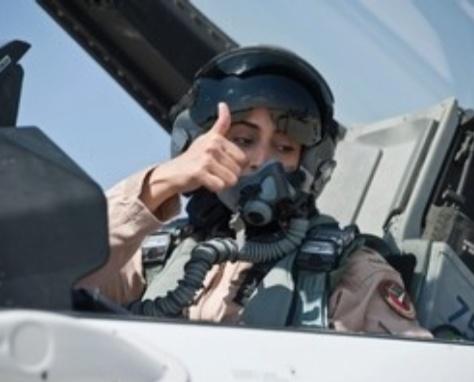
The condescension and racism behind American praise of the female pilot who bombed ISIS

0 Comments
 View image on TwitterView image on Twitter
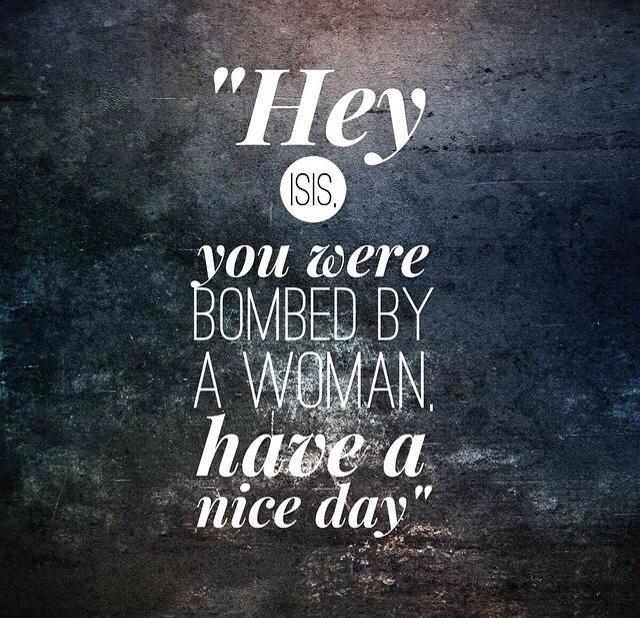
This may be the subtlest but most destructive trope of all, because it treats women's progress in the Middle East as primarily something that matters when it can be used to humiliate Muslim men. It co-opts Mansouri and Muslim women generally into a sort of practical joke that we Americans get to play on our enemies. This may help explain why commentators praising Mansouri are so often ignorant of the actual facts about the status of women in the Middle East: they care about what she represents for jingoistic insults of America's enemies, not for what she represents for female advancement.
The idea that Mansouri's gender would be an ideologically crippling humiliation for ISIS is, in itself, based in racist and Islamophobic misconceptions.
Mansouri's gender is frequently described as such a big deal because ISIS fears female soldiers. The militants, it is often said, believe that they will not go to heaven if they are "martyred" by combat with a woman. This is false, and ISIS even fields its own all-female battalions in Syria, which it uses to terrify civilian women and enforce their compliance with its oppressive laws. This misconception, which actually understates ISIS's brutality toward women, is based in reassuring Islamophobic tropes about "72 virgins" and infantalizing notions of Muslim men. If we were told that any other group of battle-hardened fighters feared female soldiers, we would laugh the idea off as ridiculous, but with Muslim groups this notion is readily embraced.
These misconceptions and stereotypes all seem to reinforce the core theme of American praise of Mansouri: our conversations often begin with the assumption that Arabs and Muslims are inherently less advanced, should be held to a lower set of standards, because that is just how they are. Our praise for Mansouri, no matter how much she deserves it, only demonstrates our unconcern for the actual status of women in the Arab Middle East.
 
back to top