Showing posts with label Pope Francis. Show all posts

Tuesday, 1 September 2015

Syriac Bishop Flavien-Michel Malk� Beatified on 100th Anniversary of His Martyrdom at the hands of the Muslim Turks

0 Comments
Glory be to God for this holy hierarch who laid down his life for his flock and earned his crown as a true witness for Christ. May we learn from him and all the martyrs to stand firm in our faith in Jesus Christ, preferring to die rather than to deny Him who laid down his life for us.
When his friends and acquaintances urged him to withdraw from Gazireh to a safer location, he replied, �Even my blood I will shed for my sheep.� 
One of the bishop�s most striking phrases comes from when he was pressured to renounce the faith and to convert to Islam. Rather than giving in, the bishop replied, �I will defend my faith to the blood.�

Syriac Bishop Will Be Beatified on the 100th Anniversary of His Martyrdom
In 1915, Flavien-Michel Malk� said, �I will defend my faith to the blood.�

Bishop Flavien-Michel Malk� of the Syriac Diocese
of Gazireh, who was martyred Aug. 29, 1915,
and will be beatified Aug. 29, 2015.
DIYARBAKIR, Turkey � On Saturday, Pope Francis approved a decree recognizing the martyrdom of Flavien-Michel Malk�, a Syriac Catholic bishop who was killed in 1915, amid the Ottoman Empire's genocide against its Christian minorities.

The decision was made during an Aug. 8 meeting between Pope Francis and Cardinal Angelo Amato, prefect of the Congregation for the Causes of Saints.

Bishop Malk� will be beatified Aug. 29, the 100th anniversary of his martyrdom, during a liturgy celebrated by Ignatius Youssef III Younan, the Syriac patriarch of Antioch, at the convent of Our Lady of Deliverance in Lebanon. It is expected that thousands of Syrians and Iraqis displaced by the Islamic State will attend the beatification.

�In these painful times experienced by Christians, especially the Syriac communities in Iraq and Syria, the news of the beatification of one of their martyrs, will surely bring encouragement and consolation to face today's trials of appalling dimension,� read an Aug. 9 statement of the Syriac Patriarchate of Antioch.

�Blessed Martyr Michael, intercede for us, and protect especially the Christians in the Orient and all the world in these hard and painful days.�

Malk� was born in 1858 in the village of Kalaat Mara, a village of the Ottoman Empire in what is now Turkey, to a Syriac Orthodox family. He joined a monastery of that Church and was ordained a deacon, but then converted to the Syriac Catholic Church. (Both the Syriac Orthodox and Syriac Catholics use the West-Syrian rite.)

After his conversion, he was ordained a priest in Aleppo in 1883. He was a member of the Fraternity of St. Ephrem and served parishes in southeastern Turkey, near his home.

Ottoman persecution of Christians began in earnest with the Hamidian massacres of 1894-1897. Malk�'s church and home were sacked and burned in 1895, and many of his parishioners were murdered, including his mother. In total, the massacres killed between 80,000 and 300,000 Christians.

He was selected to become a bishop in the 1890s, serving as a chorbishop and helping in the rebuilding of Christian villages. In 1913, he was consecrated bishop and appointed head of the Syriac Diocese of Gazireh (modern-day Cizre, 150 miles southeast of Diyarbakir).

A second round of persecution of Christians in the Ottoman Empire began in April 1915. Known as the Armenian Genocide, it targeted the Armenian, Assyrian and Greek Christian minorities in the empire. The Assyrian genocide (the portion of the mass killings directed against Syriac and Chaldean Christians) is also known as the Seyfo Massacre, from the Syriac word for sword.

Some 1.5 million Christians were killed, and millions more were displaced during the genocide.

During the summer when the genocide broke out, Bishop Malk� was in the Idil district, near Gazireh. In June 1915, hearing the Ottoman forces were preparing to massacre Gazireh's people, he returned.

According to the Syriac Patriarchate, when his friends and acquaintances urged him to withdraw from Gazireh to a safer location, he replied, �Even my blood I will shed for my sheep.�

Together with four of his priests and the Chaldean bishop of Gazireh, Philippe-Jacques Abraham, he was arrested and imprisoned for two months.

Bishop Malk� refused to convert to Islam, and on Aug. 29, 1915, he was martyred.

He was the last Syriac bishop of Gazireh; after his death, the diocese was suppressed, and, today, the Syriac Catholic Church has no presence in Turkey.

In an Aug. 8 interview with Vatican Radio, the postulator of Bishop Malk�s cause, Father Rami Al Kabalan, spoke of the bishop�s deep spiritual life as well as the relevance his martyrdom has today.

The bishop, he said, �played a fundamental role in encouraging people to defend their faith in the difficulties of the time, during the persecutions of the Ottoman Empire.�

Bishop Malk� lived a life of poverty, even selling his liturgical vestments in order to assist the poor and help fight poverty, Father Al Kabalan said.

In addition to his closeness with the poor, the priest said that Bishop Malk� was extremely zealous in his apostolate and visited all of the parishes within his diocese.

One of the bishop�s most striking phrases, his postulator said, comes from when he was pressured to renounce the faith and to convert to Islam. Rather than giving in, the bishop replied, �I will defend my faith to the blood.�

Exactly 100 years after his death, Bishop Malk�s serves as a prophetic witness because �we Christians of the East are undergoing the same persecutions, even if in a different way,� the priest said. �The image of this martyr gives us courage to defend our faith and to live our faith.�

�I personally think the beatification truly has a very strong ecclesial importance in the context of today. � We are attacked in Iraq, in Mosul, where by now the Christian community no longer exists; and in Aleppo; and now the situation of Al Qaryatain, the Diocese of Homs � we are truly the most wounded Church! We are undergoing persecution everywhere.�

Voicing his hopes for the future, Father Al Kabalan said he prays that the Lord would illuminate world leaders and those who hold power, �so that they make peace!�


Friday, 26 June 2015

Raymond Ibrahim: 'Where�s the Pope�s Encyclical on Christian Persecution?'

0 Comments
Our beloved Orthodox hierarchs also might wish to consider Raymond Ibrahim's analysis here. Mr. Ibrahim, whom I know personally, is a Coptic Orthodox Christian. We were both presenters (along with Archimandrite Daniel Byantoro) at a conference on Orthodoxy, Islam and Muslim Persecution of Christians, held at an Orthodox Church in Ohio in 2011. His is a sober and informed voice we would do well to heed.

"The Christian worldview is not about 'saving the earth'�'where moth and rust do corrupt, and where thieves break through and steal'�but in saving souls, both in the now and hereafter. The Lord questioned Saul of Tarsus as to why he was persecuting his flock, not about the environment."

by Raymond Ibrahim � June 25, 2015


Pope Francis recently released a new encyclical.  Portions of it deal with environmentalism, global warming, and climate change.  Naturally, this has prompted controversy.

It�s noteworthy that Francis didn�t merely make a passing comment on global warming during this or that sermon, but that he issued a papal encyclical on the matter.  Encyclicals are much more formal and significant than remarks made during mass.  They are letters written by a pope and sent to bishops all around the world.  In turn, the bishops are meant to disseminate the encyclical�s ideas to all the priests and churches in their jurisdiction, so that the pope�s teaching reaches every church-attending Catholic.

All this leads to the following question: Where is Pope Francis� encyclical concerning the rampant persecution that Christians�including many Catholics�are experiencing around the world in general, the Islamic world in particular?

To be sure, the pope has acknowledged it.  On April 21, during mass held at Casa Santa Marta, Francis said that today�s church is a �church of martyrs.� He even referenced several of the recent attacks on Christians by Muslims (without of course mentioned the latter�s religious identity).
Said Pope Francis:

In these days how many Stephens [early Christian martyred in Book of Acts] there are in the world! Let us think of our brothers whose throats were slit on the beach in Libya [by the Islamic State]; let�s think of the young boy who was burnt alive by his [Pakistani Muslim] companions because he was a Christian; let us think of those migrants thrown from their boat into the open sea by other [African Muslim] migrants because they were Christians; let us think � just the day before yesterday � of those Ethiopians assassinated because they were Christians� and of many others. Many others of whom we do not even know and who are suffering in jails because they are Christians� The Church today is a Church of martyrs: they suffer, they give their lives and we receive the blessing of God for their witness.

The pope is acquainted with the reality of Christian persecution around the world.  So why isn�t he issuing an encyclical about it?  Such an encyclical would be very useful.

The pope could instruct bishops to acknowledge the truth about Christian persecution and to have this news spread to every Catholic church.  Perhaps a weekly prayer for the persecuted church could be institutionalized�keeping the plight of those hapless Christians in the spotlight, so Western Catholics and others always remember them, talk about them, and, perhaps most importantly, understand why they are being persecuted.


Once enough people are familiar with the reality of Christian persecution, they could influence U.S. policymakers�for starters, to drop those policies that directly exacerbate the sufferings of Christian minorities in the Middle East.

Whatever the effects of such an encyclical�and one can only surmise positive ones�at the very least, the pope would be addressing a topic entrusted to his care and requiring his attention.

As recent as 1958, Pope Pius XII issued an encyclical that addressed the persecution of Christians.  A portion follows:

We are aware�to the great sorrow of Our fatherly heart�that the Catholic Church, in both its Latin and Oriental rites, is beset in many lands by such persecutions that the clergy and faithful � are confronted with this dilemma: to give up public profession and propagation of their faith, or to suffer penalties, even very serious ones. 
[�] 
Missionaries who have left their homes and dear native lands and suffered many serious discomforts in order to bring the light and the strength of the gospel to others, have been driven from many regions as menaces and evil-doers�

Note that Pius does not mention the burning and bombing of churches, or the abduction, rape, enslavement, and slaughter of Christians.  The reason is that Christians living outside the West in 1958 rarely experienced such persecution.  In other words, today�s global persecution of Christians is exponentially worse than in 1958.  Pius complained about how Christianity was being contained, not allowed to spread and win over converts.

Today, indigenous Christians who�ve been in the Middle East before Islam was conceived are being slaughtered, their churches burned to the ground, their women and children, enslaved, raped, and forced to convert.  �ISIS� is the tip of the iceberg.

Even in the West, statistics indicate that Islam is set to supersede Christianity, at least in numbers.

Yet no encyclical from Pope Francis on any of this.  Instead, Francis deems it more fit to issue a proclamation addressing the environment and climate change.

Whatever position one holds concerning these topics, it is telling that the pope�the one man in the world best placed and most expected to speak up for millions of persecuted Christians around the world�is more interested in speaking up for �the world� itself.

Bear in mind, the Christian worldview is not about �saving the earth���where moth and rust do corrupt, and where thieves break through and steal��but in saving souls, both in the now and hereafter.   The Lord questioned Saul of Tarsus as to why he was persecuting his flock, not about the environment.

Yet here we are: if even the Catholic Pope does not deem the ongoing, systematic assault on Christianity and Christians a priority issue in need of its own encyclical, what can be expected from the average secular/atheistic politician in the West?


Friday, 17 April 2015

European Parliament Votes to recognize Armenian, Assyrian, Greek Genocide

0 Comments
After Pope's statement, pressure builds on rapidly re-Islamizing Turkey to acknowledge its past persecution of Christians.

See also: The Orthodox Christian Holocaust: 1894 to the Present

Pravoslavie, April 16, 2015

(Brussel/Istanbul) The European Parliament backed a motion on Wednesday that calls the massacre a century ago of up to 1.5 million Armenians by Ottoman Turkish forces a "genocide", days after Pope Francis triggered fury in Turkey by using the same term.

Although the resolution repeated language previously adopted by the parliament in 1987, it could stoke tensions with EU candidate nation Turkey. Turkish President Tayyip Erdogan said even before the vote took place that he would ignore the result.

After the vote, the Turkish foreign ministry accused the European Parliament of attempting to rewrite history.

Muslim Turkey agrees that Christian Armenians were killed in clashes with Ottoman forces that began on April 15, 1915, when large numbers of Armenians lived in the empire ruled by Istanbul, but denies that this amounted to genocide.

Armenia, some Western historians and foreign parliaments refer to the mass killings as genocide.
Voting by show of hands, European lawmakers overwhelmingly backed the motion stating that the "tragic events that took place in 1915-1917 against the Armenians in the territory of the Ottoman Empire represent a genocide".

Armenia's Foreign Minister Edward Nalbandian hailed the resolution as a move aimed at defending human rights.

"The Resolution contains an important message to Turkey to use the commemoration of the centenary of the Armenian Genocide to come to terms with its past, to recognize the Armenian Genocide and thus pave the way for a genuine reconciliation between Turkish and Armenian peoples," he said in a statement.

Pope Francis sparked a diplomatic row last Sunday by calling the killings "the first genocide of the 20th century". His remarks prompted Turkey to summon the Vatican's ambassador to the Holy See and to recall its own.

The European Parliament sprang to the pope's defense, commending the message the pontiff delivered at the weekend.


"IN ONE EAR, OUT THE OTHER"

Turkey is a candidate country to join the 28-nation EU but accession talks have dragged on for years with little progress.

Earlier, Erdogan told a news conference that "whatever decision the European Parliament took on Armenian genocide claims would "go in one ear and out the other".

"It is out of the question for there to be a stain, a shadow called 'genocide', on Turkey," he said at Ankara airport before departing on a visit to Kazakhstan.

Last year, when he was Turkey's prime minister, Erdogan offered what his government said were unprecedented condolences to the grandchildren of Armenians killed during World War One.

Wednesday's resolution said such statements were a step in the right direction, but legislators urged Turkey to go further.

In a statement after the vote, Turkey's foreign ministry said lawmakers who backed the resolution were in partnership with "those who have nothing to do with European values and are feeding on hatred, revenge and the culture of conflict".


16 / 04 / 2015


Tuesday, 14 April 2015

After Irking the Turks, Pope Francis urges Christians to Speak Boldly

0 Comments
These are times of martyrdom, Francis said last week, and the martyrs of today are so many, �we can say that they are more numerous than in the first centuries.�

Related:

After Irking the Turks, Pope Francis urges Christians to Speak Boldly
by Thomas D. Williams, Ph.D. - Breitbart News
April 13, 2015

The day after publicly commemorating the Armenian genocide and risking a hostile response from Turkey, Pope Francis spoke of the need for courage to proclaim the truth boldly, no matter what the consequences.

The way of the Church is that of �openness and speaking freely,� said Francis Monday in his homily at Mass in the Santa Marta residence in Vatican City.

Drawing from the reading of the day from the Acts of the Apostles, the Pope pointed to the example of the apostles of Peter and John, who fearlessly preached Christ�s resurrection despite the threats from local authorities.

According to the account, the Apostles prayed, �Lord, take note of their threats, and enable your servants to speak your word with all boldness.�

On Sunday, the Pope announced that it was �a duty� to honor the memory of the victims of the genocide, �for whenever memory fades, it means that evil allows wounds to fester.�

�Concealing or denying evil is like allowing a wound to keep bleeding without bandaging it!� he said.

Continuing in this vein, Francis said Monday that �the path of openness and Christian courage� is still the message of the Church today. Referring to Saints Peter and John, he said that these two simple, uneducated men spoke with boldness, �without fear,� he said.

The Pope contended that on this journey of openness the �real hero is the Holy Spirit,� because he is the only one able to give us �the courage to proclaim Jesus Christ,� he said.

It is this courage in announcing Christ that distinguishes it from proselytizing, the Pope said. �We don�t advertise to attract more associates to our spiritual �business,�� the Pope said. �This is not necessary, and it�s not Christian.�

Like Saint Paul, Pope Francis suggested that what ultimately convinces people is not clever reasoning and persuasive argumentation, but the power of the message itself, and the Holy Spirit working interiorly.

The job of the Christian, Francis insisted, is to �courageously announce,� and through the Holy Spirit, �the proclamation of Jesus Christ provokes that astonishment that moves us.�

In the end, he said, �only the Spirit is able to change our attitude, the history of our lives and our identity.�

It was the Holy Spirit, Francis said, who gave �this power to simple and uninstructed people� like Peter and John, which enabled them �to proclaim Jesus Christ up to the final witness: martyrdom.�

Francis has suggested that this Christian courage is more necessary now than ever. On Sunday, the Pope reiterated his conviction that we are living in a time of war, �a third world war which is being fought piecemeal,� in which Christians are suffering �savage crimes, brutal massacres and senseless destruction.�

These are times of martyrdom, Francis said last week, and the martyrs of today are so many, �we can say that they are more numerous than in the first centuries.�


Thursday, 24 July 2014

Meriam Ibrahim lands in Rome, meets with Pope Francis

0 Comments
by Elise Harris, Catholic News Agency via Pravmir
July 24, 2014

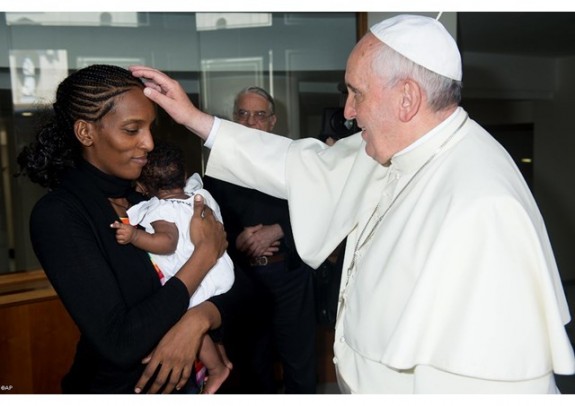
Vatican City, Jul 24, 2014 / 06:44 am (CNA/EWTN News).- A Sudanese woman spared of a death sentence for refusing to renounce her Christian faith arrived in Rome with her family Thursday, where they met with Pope Francis a few hours after landing.


Pope Francis meets Meriam Ibrahim and her child Maya at the Vatican's Santa Marta residence, July 24, 2014. Credit: ANSA/Osservatore Romano

�Pope Francis was very tender with her, her husband, who was in prison, and thanked her for her courageous witness to perseverance in the Faith,� Vatican spokesman Fr. Federico Lombardi said of the encounter in a July 24 statement.

Describing the meeting between the young family and the Roman Pontiff as �very serene and affectionate,� Fr. Lombardi explained that for him encounter was �a gesture of closeness and solidarity for those who suffer for their faith.�

According to Vatican Radio, Ibrahim and her husband Daniel Wani, a U.S. citizen, as well as their two children, 1-year-old Martin and 2-month-old Maya, who was born in prison, met the Roman Pontiff in the Vatican�s Saint Martha guesthouse at 1:00 p.m. local time.

Italian Prime Minister Matteo Renzi also welcomed the family at the airport, calling it �a day of celebration.�


In May, the 27-year-old woman was charged with abandoning Islam under Sudanese law. Because her father was a Muslim, Ibrahim was legally considered a Muslim even though her mother raised her as a Christian after her father left the family when she was 6 years old.

Despite pressure and multiple death threats, Ibrahim refused to renounce her Christian faith while in prison.

In addition to the crime of apostasy � or the abandoning of the Islamic faith � Ibrahim was also charged with adultery. Her marriage to her Christian husband was not considered valid since she was considered a Muslim.

She was to receive 100 lashes for the adultery charge and was sentenced to death by hanging for apostasy.

After having her death sentence revoked by a Sudanese court June 23 due to international pressure, Ibrahim was re-arrested along with her husband at the Khartoum airport the next day on charges of forged documents. The entire family was detained for two days, until the new charges were dismissed.

Italian news agency Corriere della Sera reported that the family has remained in the Italian embassy of the Sudanese capitol, Khartoum, since June 26 until leaving the country on a flight that landed in Rome this morning at roughly 9:30 local time.

On board the flight along with the family was Italy�s vice minister of Foreign Affairs Lapo Pistelli, who has been following Ibrahim�s case. According to the agency, Pistelli had already met Ibrahim in Khartoum July 3.

The family is set to remain in Rome for a few days, after which they will depart for New York.


Wednesday, 11 June 2014

Islamic Prayers at the Vatican an Historic Travesty

0 Comments
Anti-Christian praises to Allah resound in Rome at invitation of Pope Francis.

The utter discord between the contrite prayer (composed by Pope John Paul II) explicitly calling Christians to repent "of the words and attitudes caused by pride, by hatred, by the desire to dominate others, by enmity towards members of other religions," and the Islamic prayer (not sourced, but replete with a definitive Quranic dogmatic statement of tawhid), proclaiming, "...there is no god but You alone and You have no partner," could not be more clear.

The Islamic prayer further asserts that "associating partners" with God is of Satan, as it proclaims, "we seek refuge in You from the evil in ourselves and the evil of Satan, his partners, his godlessness and his whispering, and we seek refuge in You from godlessness."

This is all in keeping with traditional Islamic condemnation of Christianity:

Say not �Trinity�: desist: It will be better for you: For God is One God: Glory be to Him: (Far Exalted is He) above having a son. . . . (Sura 4:173)

In blasphemy indeed are those that say that God is Christ the Son of Mary. (Sura 5:19)

They do blaspheme who say: �God is Christ the son of Mary . . .� They do blaspheme who say: God is one of three in a Trinity: for there is no god except One God. If they desist not from their word (of blasphemy), verily a grievous penalty will befall the blasphemers among them (Sura 5:75,78)

The papacy has long been involved in wielding worldly influence and control, and this travesty is one of the more glaring examples. By inviting Islamic prayer at Rome, which, although thank God it did not include the infamous "Opening" (Al Fatihah) or the Muslim confession of faith (the Shehada), was still explicitly anti-Christian in its orientation, Pope Francis has wrapped his papacy in dark clouds indeed, and given great encouragement to Islamic supremacists who seek to conquer Rome, and who will see this as a sign of the approaching end times, when Islam believes it will destroy Christianity and reign over all the earth.

The complete texts of the three prayers follows below.

via

Three faiths pray for Holy Land peace
Catholic News Agency via Pravmir � June 9, 2014

Vatican City, Jun 8, 2014 / 11:33 am (CNA) - Representatives of Judaism, Christianity and Islam said prayers from their respective religious communities at Sunday�s historic �Invocation for Peace� at the Vatican, praying for peace in the Holy Land and throughout the Middle East.

The meeting gathered in one place Pope Francis, Israeli President Shimon Peres, Palestinian President Mahmoud Abbas, and the Patriarch of Constantinople Bartholomew I.
The June 8 meeting in the Vatican gardens featured prayers in Hebrew, Arabic and Italian.
Below are the official English texts of a prayer from each of the three faiths.


Jewish prayer from the Yom Kippur (Day of Atonement) service, read in Hebrew:

Your servant David said before you: �Who may discern errors? Cleanse me from hidden faults�. Cleanse us, O Lord our God from all our transgressions, purify us from our impurity and cast pure water on us and purify us, as is written by Your prophets: �I will cast clean water upon you, and you shall be cleansed from all your impurities and from all your contamination I will purify you.� And it is said: �Take words with you and return to the Lord; say to him, �Take away all guilt; accept that which is good, and we will offer up the fruit of our lips.� You are merciful, accepting those who turn back to You, and with regard to repentance You promised from the beginning, and with regard to repentance, our eyes look hopefully to You. And out of Your love or us, O Lord our God, who loved Israel Your people in Your mercy, and in Your compassion with which, You had compassion on the children of Your covenant, You granted us forgiveness of sin and the pardon of transgression and the atonement of iniquity.


Christian prayer written by St. John Paul II, read in Italian:

Let us turn with trust to God our Father,
who is merciful and compassionate,
slow to anger, great in love and fidelity,
and ask him to accept the repentance of his people
who humbly confess their sins,
and to grant them mercy.
Let us pray that contemplating Jesus,
our Lord and our Peace,
Christians will be able to repent
of the words and attitudes
caused by pride, by hatred,
by the desire to dominate others,
by enmity towards members of other religions
and towards the weakest groups in society,
such as immigrants and itinerants.
Let us pray for all those who have suffered offences
against their human dignity
and whose rights have been trampled.


Islamic prayer, read in Arabic:

Praise be to God, who created the heavens and the earth, made darkness and light, brought everything out of nothing, created us as the best part of creation, formed us in the best of forms, bestowing on us hearing, sight, intelligence, and heart. Blessed be God, best of creators.

Oh God, to you all praise, O Lord, to you all praise, O Creator of the heavens and the earth, O You who know the unknown and the manifest, O Lord of everything and its sovereign, we testify that there is no god but You alone and You have no partner, we seek refuge in You from the evil in ourselves and the evil of Satan, his partners, his godlessness and his whispering, and we seek refuge in You from godlessness and want, and we seek refuge in You so that we do not bring evil upon ourselves or bring it upon anyone else.

O God, to You all praise, much praise, good and blessed, we praise You for all the grace bestowed upon us, seen and unseen, in religion or in the world, for Your graces cannot be counted or calculated, and we ask You, our Lord, that they last forever, be preserved and blessed, and that they might help us to remember You, thank You and worship You better, until we worship You, remember You and thank You as You desire, and to You all praise, O Lord, as befits the splendor of Your face and the greatness of Your power.

O God, You are all able and we are unable, You possess all and we have nothing, You know all and we know nothing, You know hidden things, we praise You, we thank You for all that You have showered upon us and all You have done so well for us in religion and in this world, to You praise, our Lord, in first things and in the hereafter, to You praise in good times and bad, to You praise until You are gratified and to You praise when You are satisfied, to You praise after satisfaction, there is no power and no strength but in You.


Sunday, 8 June 2014

Bartholomew: Christians united, real catalysts for peace in the Middle East

0 Comments
We live in interesting times:

The Ecumenical Patriarch arrives today in Rome to take part in the prayer meeting with Pope Francis, Shimon Peres and Mahmoud Abbas. The scope of the prayer meeting goes beyond immediate results.


Pravmir � June 7, 2014


Istanbul (AsiaNews) � The Ecumenical Patriarch Bartholomew arrives tonight in Rome to participate in the prayer for peace tomorrow, at the invitation of Pope Francis.

The pontiff has invited Israeli President Shimon Peres and the Palestinian Authority, Mahmoud Abbas, to pray for peace in the war-torn Middle East where the Christian element is about to disappear.

In his letter of invitation, the Pope says that the presence of Bartholomew is �an act of continuity of their common pilgrimage to Jerusalem �. A true gift.�

In the message, the pontiff thanks Bartholomew for his insistence on a meeting in Jerusalem �which was a true gift of the Lord to worship together in those holy places and to join in prayer at the tomb of Christ, the foundation of our hope.�

Bartholomew has stressed that tomorrow�s prayer of takes on a very important significance that goes beyond any immediate results: it wants to show that it is the privileged task of Christians to be the true voice of peace in the world, in accordance with the dictates of our Lord expressed in the apostolic tradition of the true united Church.

In short, true unity among Christians is the real catalyst for true peace in the world and is the only answer to the existential problems of our small planet.

To those Christians who are hesitant towards these initiatives, the ecumenical patriarch reiterated what was said in Jerusalem: �I walked with my brother Francis of the Holy Land without the fears of Luke and Cleopas on their way to Emmaus (cf. Luke 24 13-35), but inspired by a living hope, as we learn from our Lord�.

Bartholomew also sees preparations for the celebration of 1700 years since the Council of Nicaea � of which he spoke in Jerusalem with the pope � as part of the path to peace in the world.


back to top